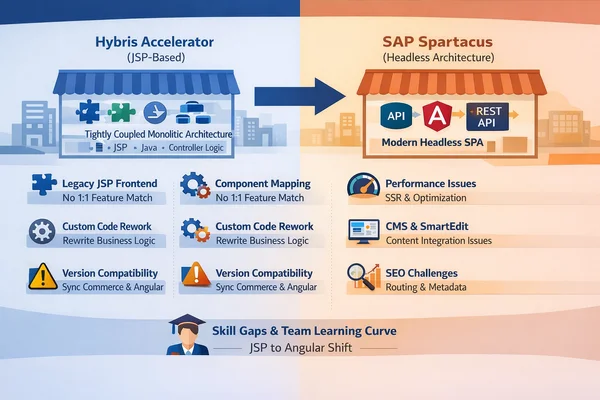
Upgrading a SAP Hybris (SAP Commerce) Accelerator-based storefront to Spartacus (now called SAP Composable Storefront) is a significant modernization effort — and one that comes with a variety of technical, architectural, process, and business challenges. This is because you’re not merely applying a patch or updating versions; you’re transitioning from a traditional, monolithic JSP-driven front end to a headless, Angular-based, decoupled architecture.
Below is a breakdown of the key challenges you’re likely to encounter:
1. Architectural and Paradigm Shift
From Monolithic to Headless
- Traditional Hybris Storefronts (Accelerators) are tightly coupled with backend logic (JSP controllers, tag libraries, etc.).
- Spartacus is headless and API-driven, requiring you to re-conceptualize how frontend and backend interact.
You must adopt OCC (Omni Commerce Connect) REST APIs in place of server-rendered pages.
This means rewriting page logic, converting UI to Angular components, and structuring the app as a Single-Page Application (SPA).
2. Spartacus Component Mapping & Feature Parity
No Direct 1-to-1 Mapping
Many components and UI elements that existed in the Accelerator storefront may not match Spartacus constructs or OCC endpoints directly.
This includes:
- Custom features
- Promotional banners
- Advanced search experiences
- Specialized payment flows
You’ll need to map existing components to Spartacus equivalents or implement custom OCC extensions where APIs don’t exist.
3. SAP Hybris Accelerator-based Storefront Custom Extensions and Integrations
Custom Code Rework
Any customized business logic that existed in the old storefront (e.g., custom Java controllers, JSP extensions) must be re-designed for Spartacus.
This includes but is not limited to:
- Custom authentication flows
- Loyalty or promotion logic
- Third-party integrations
- Custom checkout flows
In many scenarios, new Angular services and occ extensions must be developed to replicate old behavior.
4. Version Compatibility and Release Policies
Supported Software Versions
SAP enforces compatibility between:
- SAP Commerce versions
- Composable Storefront (Spartacus) versions
- Angular/node versions for development
You’ll need to carefully plan which versions to align with — often requiring:
- Commerce upgrade
- Spartacus upgrade
- Adjusting Angular/node environments
This planning can become complex, especially if you’re several versions behind.
5. Performance & SSR Challenges
Server-Side Rendering (SSR)
Spartacus supports SSR to improve performance and SEO, but it can be tricky to configure.
Performance issues such as timeouts or memory leaks may occur if SSR isn’t optimized properly.
6. SmartEdit & CMS Compatibility
If your storefront used SmartEdit or CMS-driven content, Spartacus handles this differently.
Some older Spartacus versions may not be fully compatible with SmartEdit, leading to issues during content editing workflows.
7. SEO & Routing Rework
Headless SPAs behave differently compared to server-rendered pages:
- URL structure
- Metadata management
- Crawlability
You may need to implement strategies for:
- Unique crawlable URLs (SEO friendly)
- SSR or prerendering
- Sitemap generation
Failing to do so can reduce your site’s organic visibility.
8. Team Skill Gaps
New Stack + Practices
Moving to Spartacus typically means:
- Angular development
- Modern JavaScript/TypeScript practices
- API-first thinking
- CI/CD in frontend context
If your team has primarily worked with JSP/Java backend, this is a steep learning curve.
9. Data Migration and Testing
Even though Spartacus uses the same backend (Commerce), the frontend migration often reveals gaps in data APIs:
- Missing OCC endpoints
- Need for new API contracts
- New test suites required (unit + e2e)
Thorough testing is essential to avoid regressions during rollout.
10. Project Management and Planning Challenges
Migration Strategy
You have to decide between:
- Big-bang migration (all at once)
- Incremental feature-by-feature migration
An incremental approach is generally safer because it:
- Reduces business disruption
- Allows rollout of new experiences early
- Enables bulk of legacy features to remain stable
However, it requires extra planning and parallel support for old and new storefronts.
11. End-of-Life and Long-Term Support
SAP has set deadlines for phasing out legacy storefronts. Projects still on legacy can face:
- Inability to deploy to Commerce Cloud
- Security vulnerabilities
- Lack of official support
This creates a business imperative to complete the migration by stipulated timelines.
Summary: Primary Pain Points
| Challenge Category | What Makes It Hard |
| Architecture shift | Breaking away from JSP, MVC to headless SPA |
| Component gap | No direct equivalence for many existing modules |
| Custom code | Needs rework for Angular/OCC |
| Versioning | Tight compatibility requirements |
| SEO | SPA routing & metadata challenges |
| Skills | Angular & modern frontend expertise needed |
| Testing | New framework requires comprehensive testing |
| Planning | Project Phasing + rollbacks + business continuity |
Final Takeaway
Upgrading from a Hybris storefront to Spartacus is not a routine release upgrade — it’s a technology transformation that affects architecture, code, team skills, and business process. Adequate planning, proof-of-concept work, phased rollout strategies, and a strong focus on component/API compatibility are essential for success.
Leave a Reply